
Developer – Nintendo | Publisher – nintendo
It’s easy to underestimate any game from the SNES era. It’s even easier to underestimate one that tackles fast-paced futuristic racing from that time, which is exactly what I did. I booted F-Zero from the Nintendo Switch Online app and thought I was about to stumble into awkward controls, clunky mechanics and a racer that had aged like milk and felt like I was racing through tar. What I actually found, was a new appreciation for the F-Zero series.
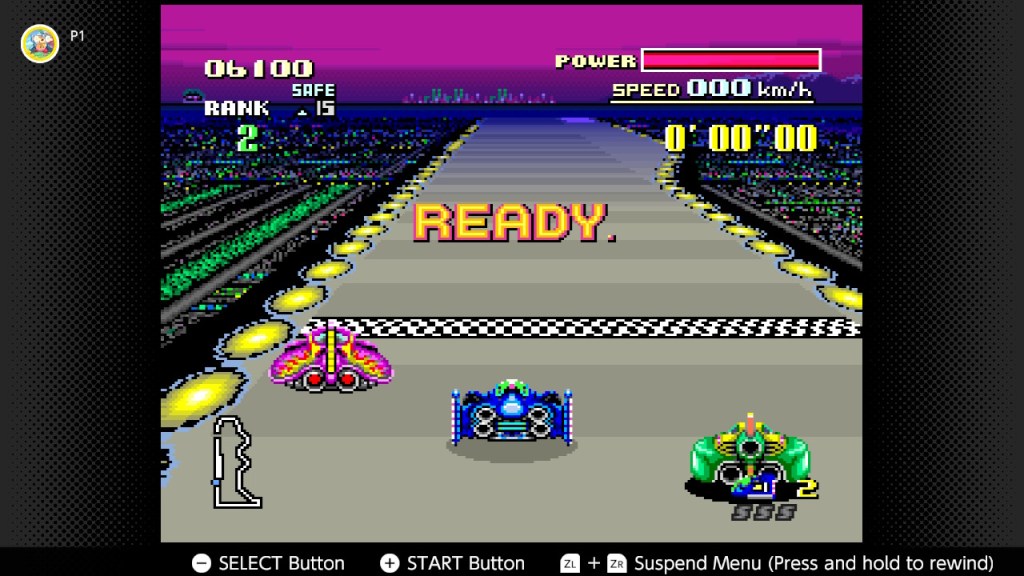
F-Zero on the SNES isn’t the perfect racer, and it does have its problems being a thirty-five year old game. The learning curve is huge and the difficulty is immense, even at the lower and middle tiers. To get good at this game, you would need to dedicate some serious time and effort to caress the curves of each course and smash records.
Despite the age of the title and the 2D graphics, the developers made use of the “Mode 7” system on the SNES, which allowed them to emulate a 3D feel with the background layer to be rotated and scaled. F-Zero is the perfect fit for this system on what we would now consider primitive hardware, with it feeling like the futuristic and high-speed racer the developers always intended.
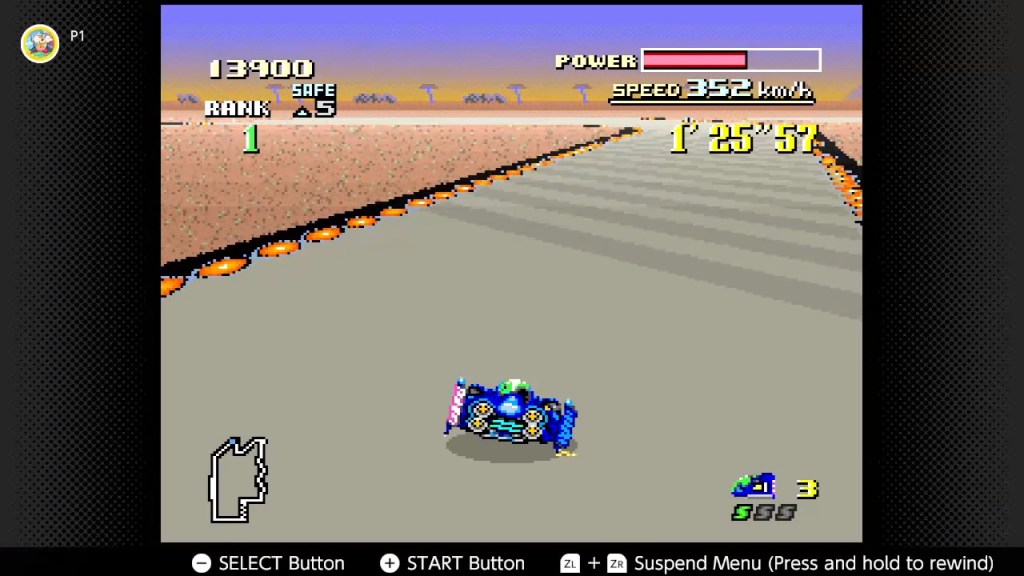
Mechanically, F-Zero has a lot of features that make it stand out from the competition from its time. Vehicles have a “Power” gauge in the top right corner of the screen, essentially indicating how much health a vehicles has. Collisions with the wall or other racers decreases this, while driving through a special zone can replenish it. When it’s low enough, your vehicle will slow down considerably, and when its finally depleted you are forced to retire from the race, which adds an interesting dynamic and forces you to tread carefully as the power gauge gets low. You can’t just speed through every course without a care in the world, you need to be in tune with each course and environment to ensure you don’t just needlessly hit a wall or other racers. You can easily bounce and spin out of control and completely squander your position.
F-Zero always wants the player to go as fast as possible while carefully navigating the course. After the first lap is complete, each racer earns “S Boost”, which can be used strategically to gain an advantage in the race against your opponents. You can stockpile up to three S Boosts to bolster your position, but vehicles become trickier to control the faster they are going.
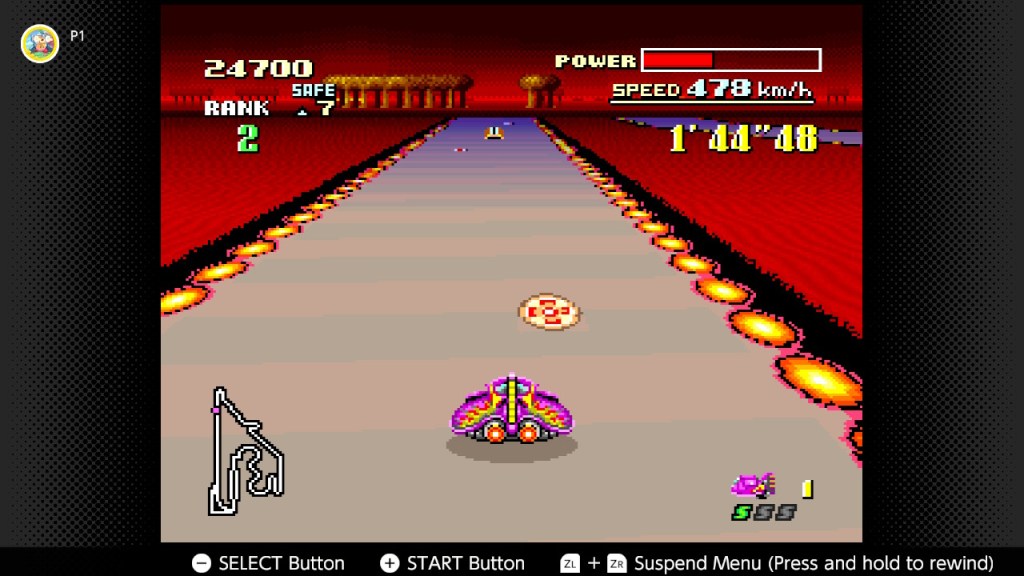
Each lap has an elimination zone, which is displayed to the left of the screen. If you fail to complete the lap in a placement higher than the elimination zone, the race is lost. It’s usually easy enough to keep within these boundaries, however in the final lap you must place in the top three. This is where the difficulty of the game itself can feel a bit punishing, especially as you attempt the higher of the three difficulties on offer. With a game from this era, though, difficulty is often inflated to keep people playing for longer. Not the best game design in 2025, but it’s present in many games from the SNES era, so can be forgiven slightly, albeit frustrating in modern times.
A lot of twists and turns in the courses can feel harsh on the back of this, with players needing to take advantage of the brakes and weighted turns of vehicles at every difficulty. I usually don’t mind the game forcing you to utilise all mechanics to that degree, but some corners were simply too harsh and felt like they were designed to frustrate the player rather than feel like good game design.
F-Zero is an exciting and inspiring first entry in the series, and it achieves exactly what it set out to do. Between the clever use of Mode 7 on the SNES for the graphics and the mostly tight controls, it’s a must-play on the old-school system. Dare I say, I thought it was better than Super Mario Kart and I look forward to experiencing the rest of the series.
8 out of 10
tested on Nintendo switch





 Everyone's Arcade
Leave a reply to doomfan1 Cancel reply