
Developer: Nintendo | Publisher: Nintendo
F-Zero is one of Nintendo’s classic franchises. One which fans adore and are longing for a new release. It has been nearly 20 years since the last F-Zero hit our screens and so I thought it was about time to delve into the past and review F-Zero X for the Nintendo 64. For those who only know Captain Falcon via Smash Bros., you’d be forgiven for thinking he’s part of some kind of forgotten Nintendo fighting franchise with his signature “Falcon Punch” and “Falcon Kick” techniques. He is part of Nintendo’s other racing franchise where we ditch the go-karts and Red Shells for gravity defying vehicles attempting to break the sound barrier. So, how does F-Zero X keep up with our modern expectations of futuristic racing? Keep reading to find out!
When I booted this game on my Switch for the first time (via Nintendo Switch Online + Expansion Pack) I was expecting an awkward, janky and generally sluggish experience. There’s no way the Nintendo 64 could have handled an exciting, superfast racer, right? I could not have been more wrong. Selecting my first race and picking Captain Falcon in his signature vehicle (the Blue Falcon) I could almost feel my eyebrows getting torn off as I accelerated through Mute City, crashing into every other racer and barrier. This game immediately blew my expectations out of the water as I had to sit back and realise that I needed to take my time to learn how to handle the high intensity this game offers.
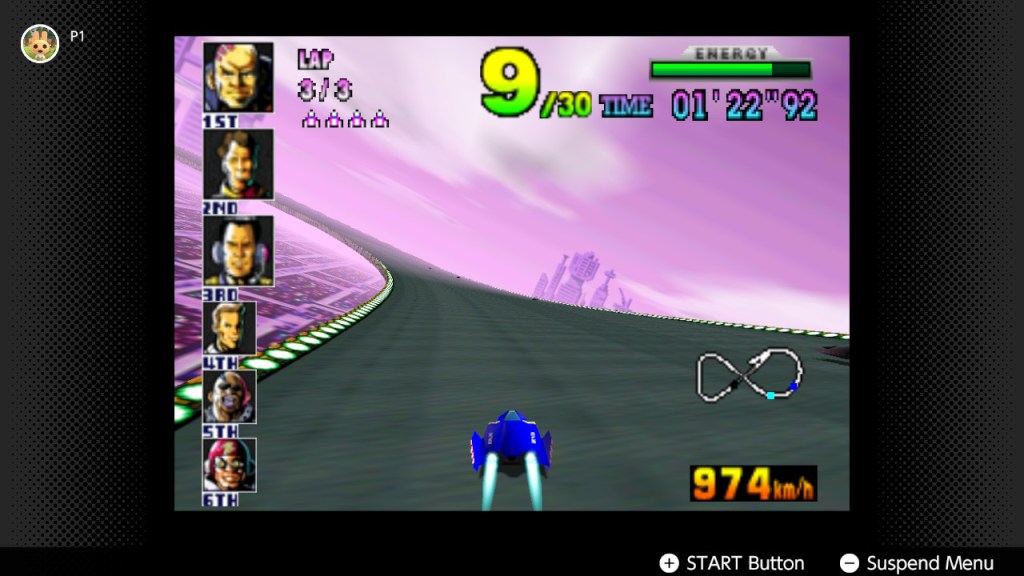
The game features a selection of modes. Grand Prix, Time Attack, Death Race, Vs Battle and practice. All of which I will delve deeper in later in this review. The bulk of the single-player is found in the Grand Prix. Players start with the choice of three competitions – Jack Cup, King Cup and Queen Cup. Each of these feature six circuits and progressively become more difficult. There is also a fourth unlockable cup, known as the Joker cup, available after beating the original three. Each cup comes with three difficulties: Novice, Intermediate and Expert. Not only are races more challenging on higher difficulties, but players have less “lives”. These lives are important as, if you get knocked off the track or deplete your energy gauge, you are forced to “retire” and lose a life, returning to the start of the race. Lose all of them and you must restart the entire Grand Prix. I will point out there is absolutely no shame in starting on Novice and I would recommend even experienced gamers to give this a shot before jumping straight into Intermediate like many might expect. This game is not forgiving in the slightest, and I absolutely love it for that.
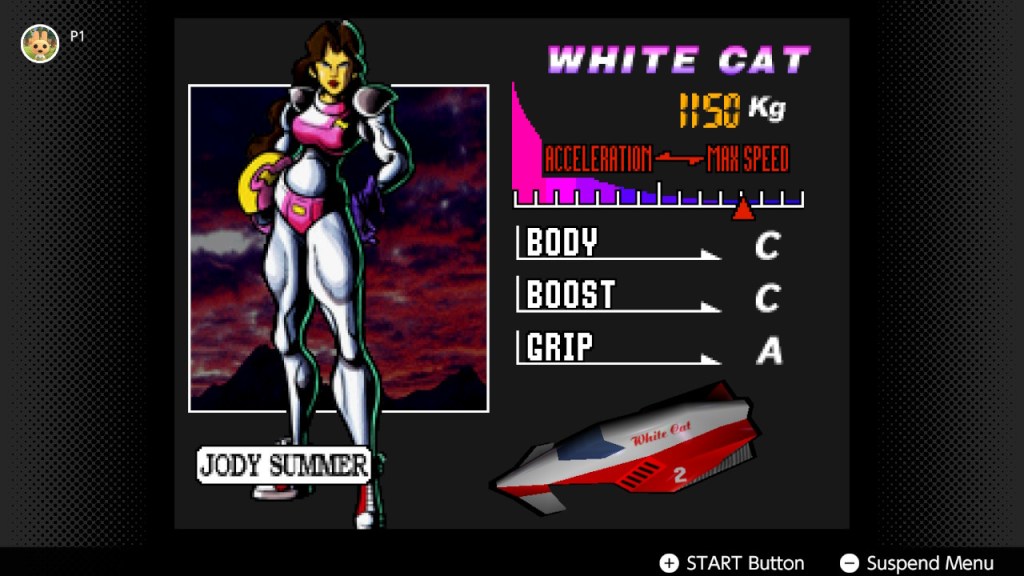
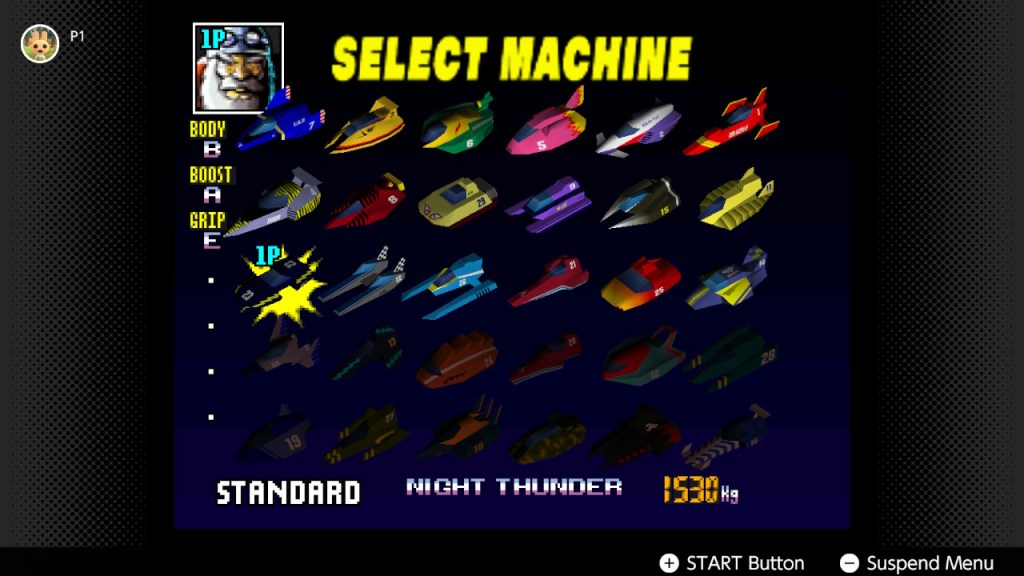
Moving on, you are given the option of which Character you wish to play as along with their signature vehicle. This is where the game begins to get a bit more technical than players might expect. Each vehicle has four stats to keep in mind, their weight, the “body”, “boost” and “grip”. Weight is measured in kilograms whereas the other three stats are measured in an alphabetical ranking, “A” being the best and “E” the worst. Body determines vehicle hit points, boost determines how much of an advantage a boost will provide and grip obviously means your vehicle hugs corners tighter and generally gives a better feel for the track. The weight of each vehicle determines things like faster acceleration for light vehicles but higher top speed for heavier ones and so on. Prior to each track, players then make one further decision, whether they would prefer their engine to focus more on acceleration or top speed. Usually this decision will be made depending on how many twists and turns a track will have. A handy little feature I was impressed by was how the game saves your settings. For example, going back to Mute City with Jody Summer meant my previous settings were already available. I could still tweak them should I want to, but I considered this a valuable Quality of Life setting that I did not expect to see in a game of this era. Even Mario Kart 8 DX doesn’t save your load-outs and preferences to this degree. Some may consider the abundance of choice intimidating, but after a few races it is very easy to determine which set up is best for you as an individual.
With all of this in mind, it would be nice if this information was readily available in a tutorial. Being such a product of its time, all of this very useful information is stored away in the instruction manual which would usually come in the box. Unfortunately, Nintendo Switch Online doesn’t have any way of accessing this information. Fortunately Nintendo of Europe have a handy scan of the full manual here, which I very highly recommend newcomers read before even booting up this game.
Upon booting the first Grand Prix, I noticed that only six vehicles were available. The manual confirms that, to unlock each additional row of racers, players must place first, second or third in the Grand Prix and earn an “x” mark, which will display in the selection screen. After earning three marks, the next row of vehicles unlocks and so on. I loved this aspect personally as it provides incentive to not only complete the novice mode, but push yourself to beat the further difficulty settings. This is something I feel modern games often lack in a way to push people to play online with a full roster usually readily available immediately upon booting a game.
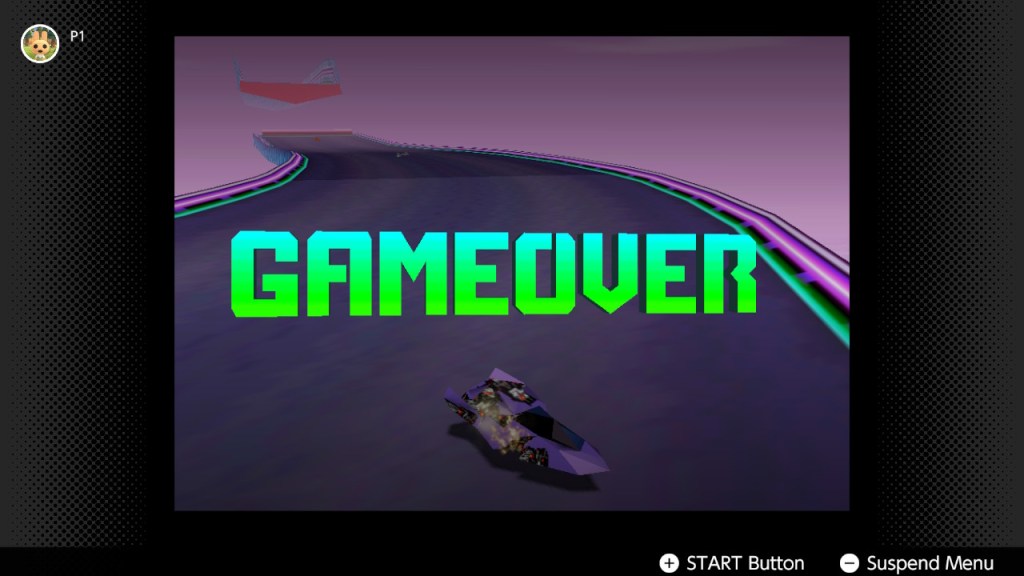
Each course consists of many twists, turns, some obstacles and ground hazards. When racing through on the first lap, there is an energy gauge in the top right of the screen which will slowly deplete should the player collide with others or manage to hit obstacles. This gauge becomes even more useful from the second lap. Players are greeted with a familiar “You’ve got Boost Power!” sound-bite and will now be able to utilise the boost ability. This drains the energy gauge when used. If this gauge hits zero, the player’s vehicle will dramatically explode and a “retired” screen appears. This means starting that race again and losing a life. Tactically timing the perfect boosts when you are low on energy and swiftly avoiding obstacles and other racers while making a last ditch attempt to reach pole position is incredibly satisfying and what F-Zero is all about. For every frustrating “Retired” screen there are about five or six instances of sheer “heart-in-my-mouth”, did I just do that!?” moments. As I said earlier in the review, starting on Novice is by no means a shameful thing to do and getting to grips with the mechanics and controls of this game is incredibly rewarding when pulling off tight manoeuvres at incredible velocity. This is far beyond an average arcade racer, there are many things to consider.
Each circuit is finely designed with anti-gravity mechanics such as racing upside down, racing around tubes and within half-pipes. The genius with these sections is how they affect the way you drive. For example, the tubes twist and turn, so driving on the outside will be very dangerous at high speeds, where players can easily lose traction and fall right off the track. Half-pipes are less dangerous yet still require a keen eye on other drivers who can bump into you and simply knock you out, forcing an early retirement. Furthermore, racing players can bump into enemies by either double-tapping “Z” or “R” (buttons will vary depending on the controller used) this allows players to effectively attack other racers and deplete their gauge. Hitting other players at the right time will force them into retirement meaning there is one less racer to concern yourself with. In doing so, you will earn a star on your HUD which will slightly replenish your energy gauge. Earning five stars will replenish one life. Precision is key here, as it is very easy to miss and end up forcing yourself off the course and into retirement. The reward is high but it brings equal risk.
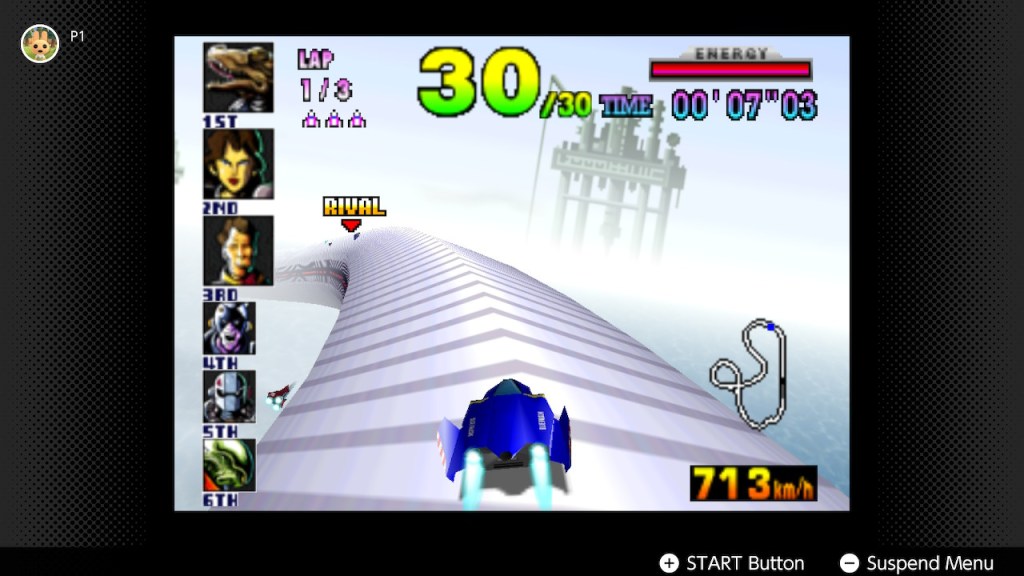
Time Trial mode is exactly what you would expect, a way to test yourself around each track without the interference of other racers and to set records for each course. Ghost Save Data is available and, unlike Mario Kart 64, does not alert you to insert an N64 controller pak. This means Ghosts actually save meaning no problems for users to be able to go back to time after time and test themselves to beat their own high scores. Though it may be considered a relatively shallow mode, this could be fun for households where multiple people might be playing the same game or for those that really want to finesse their racing skills and test themselves.
Next, we have the aptly named Death Race. In this mode you race in a straight line, inside a loop and back to the starting place with 29 other CPU racers. The idea of this mode is to be the last player standing, while attempting to knock other racers either off the course or to hit them and deplete their energy gauge. As a single-player experience this mode can be long and unexciting, I would say this is the worst mode in the game with untapped potential. Multiplayer would help, yet wouldn’t rescue it. In a modern gaming age where Battle Royale modes are huge, it’s a surprise Nintendo hasn’t at least attempted to revive this mode as a free-to-play title of some sort at the very least.
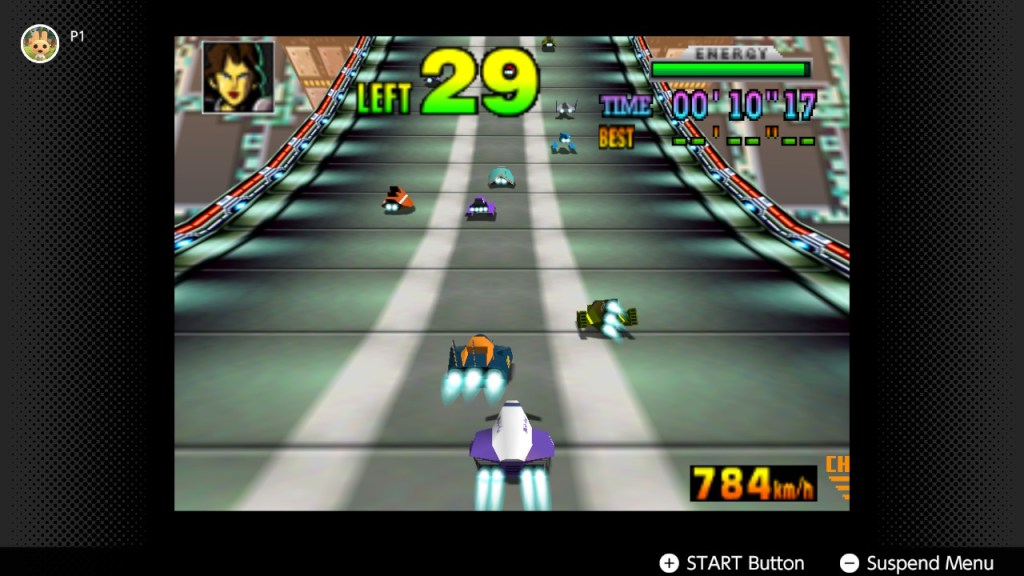
Practice mode is designed for players to loop around particular courses at their leisure with rival racers on track. Players will have the opportunity to freely pause and try different vehicles or switch tracks. There are no laps in this mode, so players could go on as long as they want. With the bulk of the single player focussing around Grand Prix mode, this is an absolute God-Send for those wanting to up their game without the pressure and frustrations of losing out mid-cup.
This game also features Vs Mode, originally designed for local multiplayer on the Nintendo 64, but thanks to Nintendo Switch Online – Expansion Pack, players can now enjoy races with friends online. Players can enable “Vs Slot” in this mode, which means if anyone retires during this race they will have the opportunity to use a slot machine which features the portraits of all of the other characters, a skull, an X or Mr Zero. Depending on what the slots land on can drastically change the outcome of the race by draining a specific pilot’s energy gauge to zero, reducing the player in first place’s energy to zero and so on. This can cause interesting dynamics which can either help the remaining player(s) or significantly hinder them. The twist in standard races with the slots make for a dynamic and fun multiplayer experience, but can also be disabled for those looking for a more traditional race.
F-Zero X is a fantastic game and in my opinion probably the best currently available on the Nintendo Switch Online – Expansion Pack. It has aged incredibly well and I found the emulation of this particular title to run smoothly. Controls also translated nicely to the Joy-Con. I had huge amounts of fun both by myself and with friends and would highly recommend it for anyone who enjoys racing games, or for those curious about the F-Zero series and are looking for a starting point. As a typical arcade racer, it’s impossible not to certify this game for everyone. Sure, there are difficulty spikes but the game can be enjoyed at all levels and is incredibly easy to pick up after long periods of leaving it be. Part of the joy of it being on the Nintendo Switch means that if I am growing bored of my current session, or my child has just been sick and ruined all of her bedding, it doesn’t matter. I can put this fine specimen of a game into sleep mode and pick back up in a moments notice. I am baffled that Nintendo haven’t returned to this series in nearly two decades when there is so much they could do, even if just remaking this title. Do not sleep on this.
9 out of 10
tested on Nintendo switch
 Everyone's Arcade
Leave a comment